
Matcha vs Green Tea: What's the Difference? (Comparison)
What is the difference between matcha and green tea? Discover the differences in cultivation, taste, nutritional value, and price in this complete comparison.
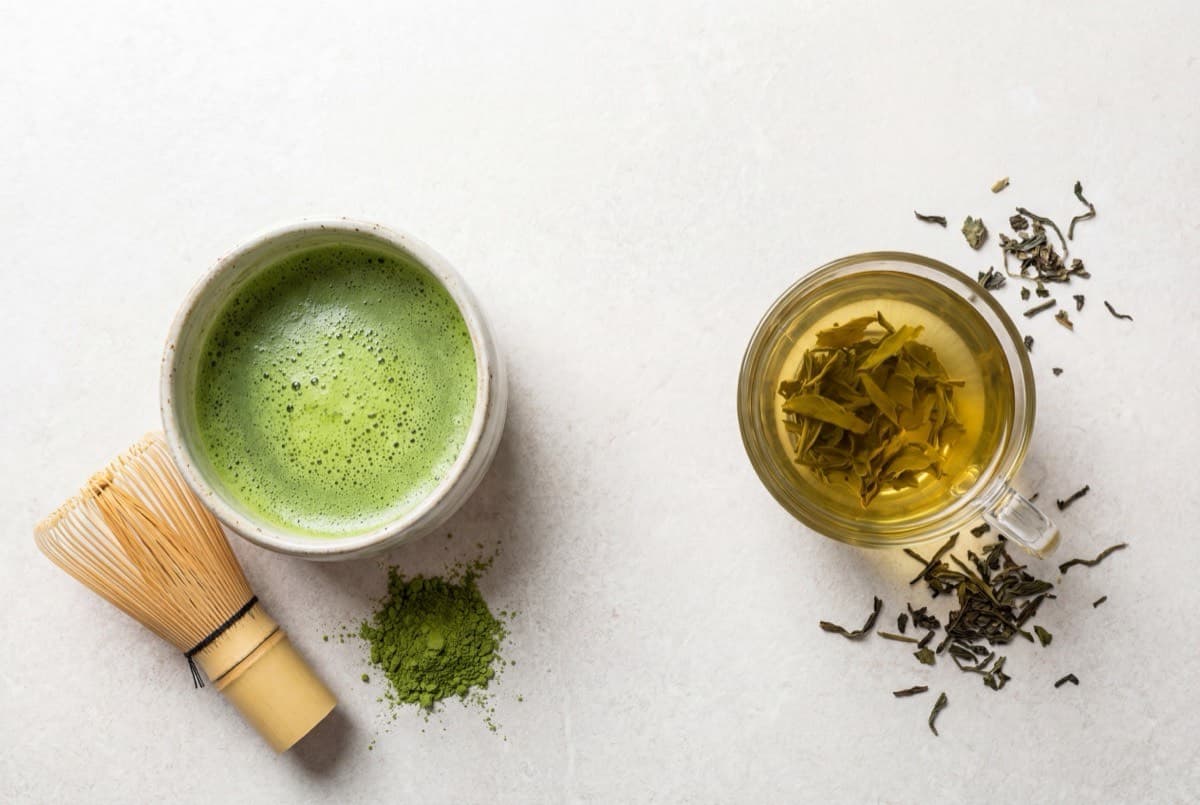
Matcha vs green tea: what's the difference?
Matcha and green tea both come from the same plant — the Camellia sinensis — but that's largely where the similarities end. Although matcha is technically a form of green tea, there are enormous differences in cultivation, preparation, taste, nutritional value, and price. In this comprehensive article, we compare matcha and green tea on all the important points, so you know exactly what the differences are and which choice suits you best.
Whether you're a seasoned tea drinker or just starting your journey into the world of tea — after reading this article, you'll know exactly where you stand. And if you want to get started with matcha right away, browse our [matcha powder collection](/shop?collectie=matcha-poeder).
What is green tea?
Green tea is one of the most consumed types of tea in the world. It's made from the leaves of the Camellia sinensis plant, which are quickly heated (steamed or pan-fired) after picking to prevent oxidation. This allows the leaves to retain their green color and much of their natural nutrients.
When drinking green tea, you steep the leaves in hot water — similar to how you use a tea bag. After steeping, you remove the leaves and drink the infusion. This means you only extract a portion of the nutrients from the leaves; the rest stays behind in the leaves you throw away.
Green tea comes in many varieties, from Chinese Longjing and Gunpowder to Japanese sencha and bancha. Each variety has its own flavor profile, but they all share the same basic preparation: steeping leaves in water.
What is matcha?
Matcha is a special form of Japanese green tea that is fundamentally different from regular green tea. The word matcha literally means 'ground tea' in Japanese, and that describes exactly what it is: tea leaves ground into an ultrafine powder.
The crucial difference starts with cultivation. Matcha tea plants are shaded with special cloths three to four weeks before harvest. This shading process — known as kabuse — forces the plant to produce extra chlorophyll and amino acids, resulting in a more intensely green color and a richer taste.
After harvest, the leaves are steamed, dried, and stripped of stems and veins. The remaining leaf material, called tencha, is then slowly ground on granite stone mills into a velvety smooth powder. This grinding process is so slow that one mill produces only 30 to 40 grams of matcha per hour.
When drinking matcha, you mix the powder completely with water — so you consume the entire leaf. This is the fundamental difference from regular green tea and the reason why matcha is so much more nutritious. Read more about matcha in our [guide for beginners](/blog/matcha-voor-beginners).
The cultivation process: where the difference begins
The biggest difference between matcha and green tea arises on the tea plantation, well before the tea ends up in your cup.
Green tea: grown in sunlight
Regular green tea grows in full sunlight. The tea plants receive direct sunlight all day, which ensures normal photosynthesis. The leaves produce catechins — powerful antioxidants — as a reaction to the sunlight. This gives green tea its characteristic slightly bitter taste.
The leaves are harvested throughout the season, with the first harvest (shincha or ichiban-cha) considered the best quality. After picking, the leaves are quickly steamed or pan-fired to stop oxidation, then rolled and dried.
Matcha: shaded for superior quality
Matcha tea plants undergo a unique shading process. Three to four weeks before harvest, the plants are covered with special bamboo mats or black plastic cloths that block 85 to 90 percent of the sunlight.
This shading process has profound effects on the chemical composition of the leaves:
- More chlorophyll: The plant produces extra chlorophyll to compensate for the lack of sunlight, resulting in the characteristic bright green color of matcha.
- More L-theanine: The amino acid L-theanine, which is normally converted into catechins by sunlight, remains present in higher concentrations. This gives matcha its characteristic umami taste and calming effect.
- Softer flavor profile: Due to the higher L-theanine and lower catechin concentrations, matcha tastes softer and less bitter than regular green tea.
This labor-intensive cultivation process is one of the reasons why matcha is more expensive than regular green tea, but also why it contains so many more nutrients. Read more about the background in our article on the [Japanese tea ceremony](/blog/japanse-theeceremonie).
Preparation: steeping versus whisking
The way you prepare green tea and matcha is completely different.
Preparing green tea
Green tea is prepared by letting the leaves (loose or in a bag) steep in hot water. The ideal water temperature is 70 to 80 degrees Celsius, and the steeping time varies from 1 to 3 minutes depending on the type. After steeping, you remove the leaves.
This is a simple process requiring little special equipment — a teapot or mug and a strainer will do.
Preparing matcha
Preparing matcha is a completely different ritual. You scoop 1 to 2 grams of matcha powder into a bowl (chawan), add 60 to 80 ml of water at about 80 degrees, and whisk the mixture with a bamboo whisk (chasen) in a rapid W or M motion until a fine, creamy layer of foam forms.
For preparing matcha, you ideally need the following accessories:
- A [bamboo matcha whisk (chasen)](/product/bamboe-matcha-klopper-chasen-6-11-cm-80-tanden) with at least 80 tines
- A [bamboo matcha spoon (chasaku)](/product/bamboe-matcha-lepel-chasaku-18-cm) for the right dosage
- A [matcha bowl (chawan)](/product/tokyo-design-studio-matcha-kom-kobiki-wit-13-8-cm-500-ml) with enough room to whisk
Although you can also prepare matcha with a milk frother or mini whisk, a traditional chasen gives the best result. Read our step-by-step guide on [how to make matcha tea](/recepten/matcha-thee-maken) for the perfect preparation.
Additionally, you can also use matcha for lattes, smoothies, and pastry — something that's much harder with loose green tea leaves. Try, for example, our recipe for a [matcha latte with oat milk](/recepten/matcha-latte-havermelk) or a refreshing [iced matcha latte](/recepten/iced-matcha-latte-recept).
Taste: subtle versus intense
The taste of green tea and matcha differs significantly, which makes sense given the differences in cultivation and preparation.
Taste of green tea
Green tea generally has a light, fresh, and somewhat grassy flavor profile. Depending on the variety, the taste can range from sweet and floral (like Japanese sencha from the first harvest) to robust and slightly bitter (like Chinese Gunpowder). The taste is typically subtle and refined, with a thin body.
If you steep green tea too long or use water that's too hot, it can quickly become bitter. Proper preparation is therefore essential for a good taste experience.
Taste of matcha
Matcha has a much more intense and complex flavor profile. High-quality ceremonial grade matcha tastes creamy, smooth, and has a pronounced umami taste — that savory, full flavor you also know from Parmesan cheese or dashi broth. There is a light natural sweetness and barely any bitterness.
Culinary grade matcha is slightly more robust and may have some more bitterness, which actually makes it suitable for use in lattes and recipes where matcha is combined with milk or sugar.
The body of matcha is much fuller and creamier than that of green tea, which comes from consuming the complete leaf. It's a completely different drinking experience. Curious which grade suits you best? Read our article on [ceremonial vs culinary grade matcha](/blog/ceremonial-vs-culinary-grade-matcha).
Nutritional values compared
This is where it gets really interesting. Because you consume the full leaf with matcha instead of just an infusion, the nutritional values are significantly higher.
Antioxidants
Matcha contains up to 137 times more EGCG (epigallocatechin gallate, the most powerful catechin) than regular green tea. This is the most cited difference and it's enormously significant. EGCG is one of the most powerful natural antioxidants and is associated with numerous health benefits.
Measured in ORAC values (a measure of antioxidant capacity), matcha scores around 1384 units per gram, while regular green tea scores around 253 units per gram. Matcha thus contains more than five times as many antioxidants per gram.
Caffeine
A cup of matcha contains an average of 30 to 50 mg caffeine, while a cup of green tea contains about 20 to 30 mg. Matcha thus has more caffeine, but the effect is very different thanks to the high concentration of L-theanine.
With green tea, the caffeine is absorbed relatively quickly, which can lead to a slight peak followed by a dip. With matcha, the L-theanine ensures that caffeine is absorbed more gradually, resulting in long-lasting, stable energy for 4 to 6 hours. Curious how matcha compares to coffee? Read [matcha vs coffee](/blog/matcha-vs-koffie).
L-theanine
This is where matcha truly excels. Due to the shading process, matcha contains up to five times more L-theanine than regular green tea. L-theanine is an amino acid that stimulates alpha waves in the brain, leading to a state of calm alertness.
The combination of caffeine and high concentrations of L-theanine is unique to matcha and is often called the perfect combination for focus and productivity. You get the energy of caffeine with the calm of L-theanine — the best of both worlds.
Other nutrients
Below is an overview of the most important nutritional values per serving:
- Chlorophyll: Matcha contains significantly more chlorophyll due to the shading process. Chlorophyll is a natural detoxifier.
- Fiber: Because you consume the entire leaf, matcha contains more fiber than a cup of green tea.
- Vitamins and minerals: Matcha contains more vitamin A, vitamin C, vitamin E, selenium, and zinc than green tea.
- Amino acids: In addition to L-theanine, matcha also contains higher concentrations of other amino acids.
For a complete overview of all health benefits, read our article on the [benefits of matcha](/blog/matcha-voordelen).
Price compared
Let's be honest: matcha is more expensive than regular green tea. But that higher price is well justified.
Why is matcha more expensive?
- Labor-intensive cultivation: The shading process, careful harvesting, and removing stems and veins require a lot of time and labor.
- Slow grinding process: The granite mills produce only 30 to 40 grams per hour.
- Lower yield: Not all leaves are suitable for matcha; only the youngest, most tender leaves are used.
- Quality control: Good matcha requires strict quality controls at every step of the process.
Price per cup
When you look at the price per cup, the difference becomes smaller than you might think. For a cup of matcha, you use 1 to 2 grams of powder. A 30-gram bag thus yields 15 to 30 cups. With good quality matcha, you end up at about 0.80 to 1.50 euros per cup.
A cup of good quality green tea usually costs 0.20 to 0.50 euros per cup. Matcha is thus two to three times more expensive per cup, but you also get five to ten times more nutrients in return.
Browse our [webshop](/shop) for current prices of our matcha products. Also read our [matcha buying guide](/blog/matcha-kopen-gids) for tips on finding the best price-quality ratio.
When to choose green tea?
Green tea is an excellent choice in the following situations:
- You want a light, subtle taste: If you prefer a fresh, light drink without the intensity of matcha.
- You're sensitive to caffeine: Green tea contains less caffeine than matcha, so if you want to limit caffeine intake, green tea is a better option.
- You have a limited budget: Green tea is cheaper than matcha and still offers a good dose of antioxidants.
- You want variety: There are dozens of different types of green tea to discover, each with its own flavor profile.
- You like simple preparation: Preparing green tea is simpler than matcha and doesn't require special accessories.
When to choose matcha?
Matcha is the better choice if:
- You want maximum nutritional value: Matcha offers many times more antioxidants, L-theanine, and other nutrients than green tea.
- You need long-lasting energy: The combination of caffeine and L-theanine in matcha provides 4 to 6 hours of stable energy.
- You want to improve focus and concentration: The high L-theanine concentration makes matcha ideal for studying or working.
- You want to incorporate matcha into recipes: From lattes and smoothies to pancakes and desserts — matcha is incredibly versatile. Check our [recipes](/recepten) for inspiration.
- You're looking for a ritual: Preparing matcha the traditional way is a meditative moment of calm in your day.
- You want to switch from coffee: Matcha is the ideal alternative to coffee thanks to its long-lasting energy without a crash. Read more about [switching from coffee to matcha](/blog/overstappen-koffie-naar-matcha).
Can you combine matcha and green tea?
Absolutely. Many tea lovers drink both matcha and green tea, depending on the moment. A cup of matcha in the morning for energy and focus, and a lighter green tea in the afternoon as a calmer alternative. This way you enjoy the best of both worlds.
Curious how much matcha you can drink per day alongside green tea? Read our article on [how much matcha per day](/blog/hoeveel-matcha-per-dag) for detailed advice.
Frequently asked questions
Is matcha the same as green tea?
Matcha is technically a form of green tea, but the cultivation, processing, preparation, and nutritional value are fundamentally different. With matcha, you consume the entire leaf as fine powder, while with green tea you only drink an infusion of the leaves.
Is matcha healthier than green tea?
Yes, matcha contains significantly more antioxidants (up to 137 times more EGCG), more L-theanine, more chlorophyll, and more vitamins and minerals than regular green tea. This is because with matcha you consume the entire leaf.
Does matcha taste the same as green tea?
No, matcha tastes much more intense and complex than green tea. Good matcha has a creamy, umami-rich taste with a natural sweetness, while green tea tastes lighter and fresher.
Can I use matcha as a replacement for green tea?
Yes, you can drink matcha instead of green tea. Keep in mind that matcha contains more caffeine. If you're switching, start with a smaller amount and build up slowly.
Why is matcha so much more expensive than green tea?
The higher price of matcha comes from the labor-intensive shading process, the slow grinding process on granite mills, the lower yield per plant, and the strict quality requirements.
Which should I choose as a beginner?
If you're new to the world of tea, green tea is a low-barrier entry point. But if you're willing to invest a bit more and want to benefit from maximum health benefits, we recommend starting directly with matcha. Read our [guide for beginners](/blog/matcha-voor-beginners) to get started.
Conclusion: matcha wins on nutrition, green tea on simplicity
The comparison between matcha and green tea yields a clear picture. Matcha wins convincingly in the areas of nutritional value, antioxidants, L-theanine, and versatility. Green tea scores better on simplicity of preparation, price, and mildness in caffeine.
If you want to get the most out of your tea — in terms of health, energy, and taste experience — then matcha is the clear winner. It's an investment in yourself that pays off daily in more energy, better focus, and a sense of well-being.
Ready to try matcha? Browse our [matcha collection](/shop?collectie=matcha-poeder) for premium Japanese matcha, or discover our [accessories](/shop?collectie=accessoires) for the perfect preparation. Have questions? Check our [FAQ page](/faq) or get in touch.
Disclaimer: this article is purely informational and not medical advice. Always consult a doctor for health-related questions.