What Is Matcha? Everything You Need to Know
What exactly is matcha, how is it made, and what does it taste like? Discover everything about this Japanese green tea powder — from its origins to preparation.
What is matcha?
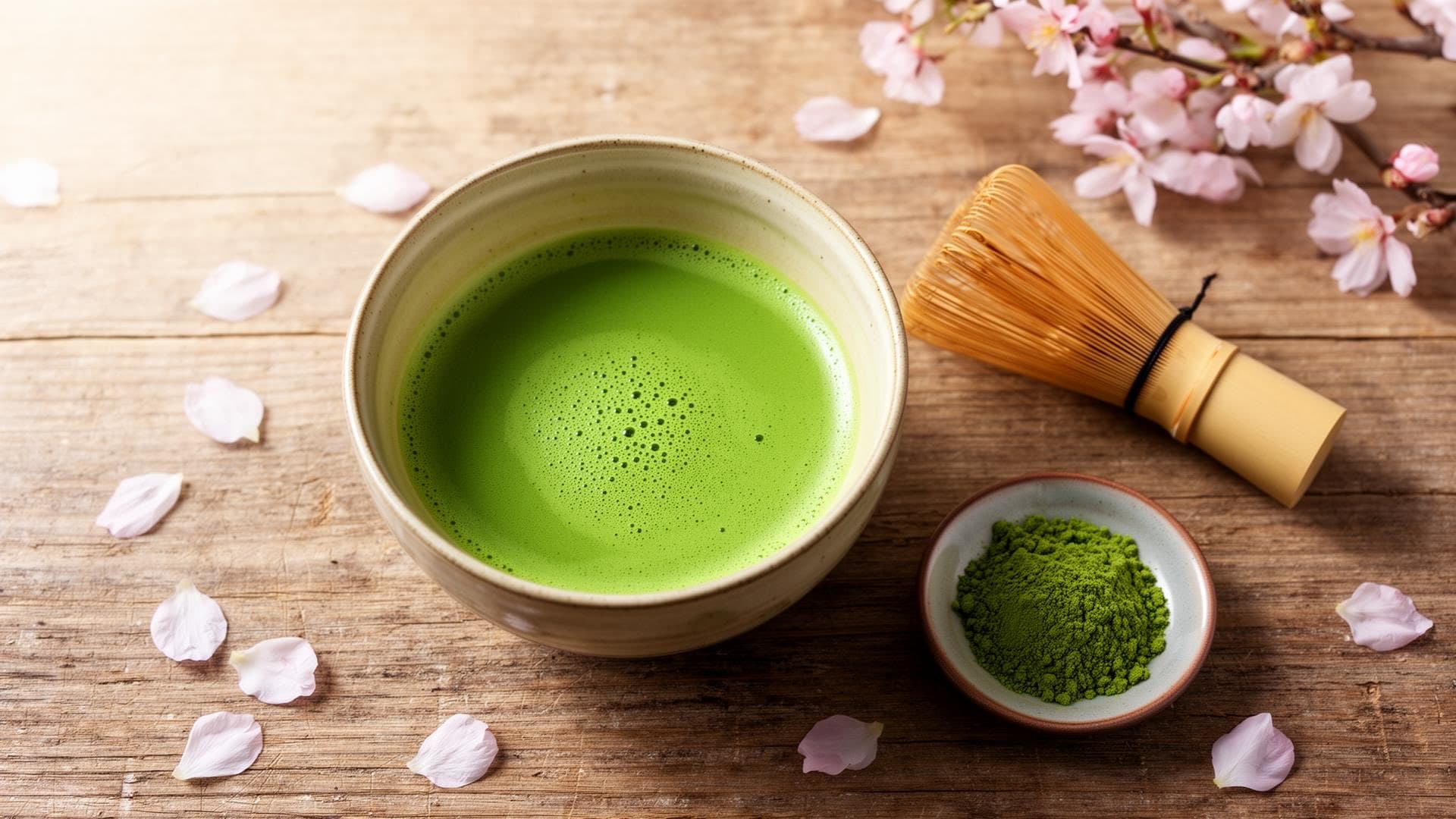
Matcha is a Japanese green tea in powdered form. Unlike regular green tea, where you steep the leaves and discard them, with matcha you consume the entire leaf — ground into a vibrant green powder. This means you get all the nutrients and flavours in concentrated form.
The word "matcha" (抹茶) literally means "ground tea" in Japanese. It has been used for centuries in the Japanese tea ceremony and has become enormously popular across Europe in recent years.
How is matcha made?
The production process of matcha is remarkable and sets it apart from every other type of tea:
- Shading: 3–4 weeks before harvest, the tea plants are covered. This increases the chlorophyll content (the green colour) and L-theanine (the calming compound)
- Hand-picking: Only the youngest, most tender leaves are picked by hand
- Steaming and drying: The leaves are steamed to halt oxidation, then dried
- De-stemming: Stems and veins are removed — what remains is called tencha
- Grinding: The tencha is slowly ground on granite stone mills into an ultra-fine powder
This entire process makes matcha more labour-intensive and therefore more expensive than regular green tea. A single stone mill produces only 30–40 grams per hour.
What does matcha taste like?
The taste of matcha depends heavily on its quality:
- Ceremonial matcha (highest quality): smooth, creamy, slightly sweet with a distinct umami flavour. No bitterness
- Culinary matcha (lower grade): more earthy and bitter, intended for recipes and lattes where the flavour is blended with other ingredients
Good matcha does not taste bitter. If you find matcha bitter, you have probably tried a lower quality or the water was too hot (above 80 °C).
Matcha vs regular green tea
The key difference: with green tea you steep the leaves and throw them away. With matcha you consume the entire leaf. As a result, matcha contains:
- Up to 137× more antioxidants (EGCG) than regular green tea
- More L-theanine — the compound responsible for calm alertness
- More caffeine — but thanks to the L-theanine it feels gentler than coffee
Curious about all the differences? Read our detailed comparison in the article matcha vs green tea.
What types of matcha are there?
There are two main categories:
Ceremonial matcha (Ceremonial Grade)
The highest quality, meant to be drunk pure with just water. Characteristics: vivid green colour, smooth taste, fine powder. This is what you will find with us as ceremonial matcha.
Culinary matcha (Culinary Grade)
Stronger flavour, designed for recipes: lattes, smoothies, pastries and desserts. Slightly more affordable but still genuine Japanese matcha. Check out our matcha for baking.
There are also organic variants — our organic matcha is certified organically grown in Japan.
How do you make matcha?
The traditional preparation is straightforward:
1. Sift 1–2 grams of matcha powder into your bowl to prevent lumps
2. Add 70 ml of water at 80 °C (not boiling!)
3. Whisk vigorously with a bamboo whisk (chasen) in a W-motion until frothy
4. Drink directly from the bowl
You will need a few basic accessories: a matcha bowl (chawan), a bamboo whisk, and a matcha scoop. Check out our complete guide to making matcha tea.
Health benefits of matcha
Matcha is well known for its health benefits:
- Energy without the crash — caffeine + L-theanine provides 4–6 hours of steady energy
- Better focus — L-theanine promotes alpha waves in your brain
- Rich in antioxidants — protects cells against free radicals
- Metabolism support — EGCG may aid fat burning
Read more about all the matcha benefits in our comprehensive overview.
Where does matcha come from?
Authentic matcha comes from Japan. The most important tea regions are:
- Uji (Kyoto) — the most prestigious region, known for its smooth, complex flavours
- Kagoshima — southern Japan, milder climate, fresh flavours
- Shizuoka — Japan's largest tea-producing region
At The Matcha Shop, all our matcha comes directly from these Japanese regions. Browse our selection in the matcha powder collection.
How much matcha per day?
Most experts recommend 1–3 cups of matcha per day. That amounts to 2–6 grams of matcha powder. Read more about the recommended amount in our article how much matcha per day.
Buying matcha: what to look for?
When buying matcha, pay attention to:
- Colour: vivid green = good quality, yellow-green or brown = lower quality
- Origin: Japan is the only source of true premium matcha
- Grade: ceremonial for drinking pure, culinary for recipes
- Freshness: matcha tastes best within 1–2 months of opening
Want more tips? Read our complete matcha buying guide.