The Japanese Tea Ceremony: History, Ritual, and Philosophy
Discover the Japanese tea ceremony — from centuries-old history to the step-by-step ritual. Learn how to create your own matcha ceremony at home.
What is the Japanese tea ceremony?
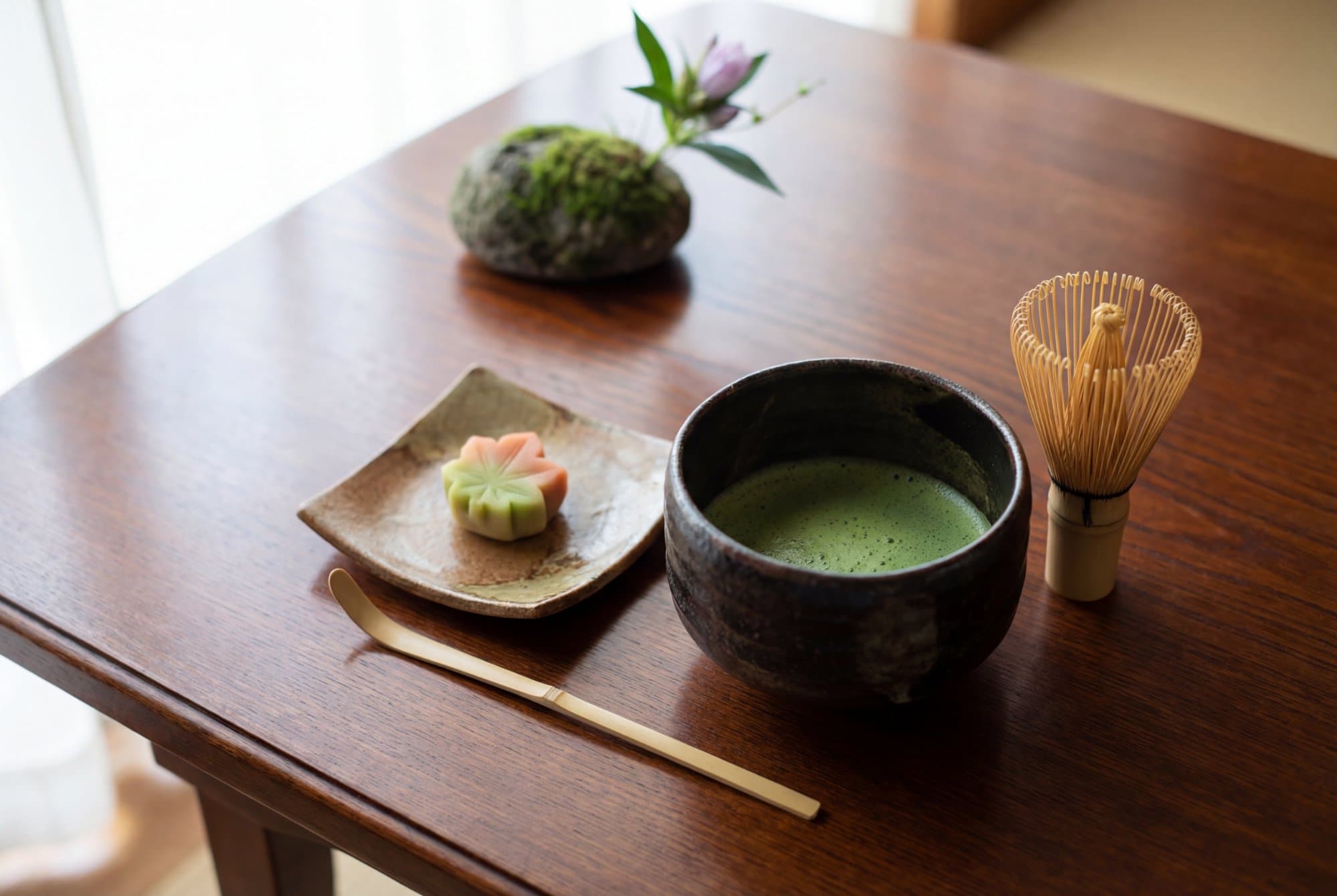
The Japanese tea ceremony, or chanoyu, is a centuries-old ritual in which [matcha tea](/shop?collectie=matcha-poeder) is prepared and served according to established principles. It is more than just drinking tea — it is a meditative practice that centers on calm, attention, and respect for the moment. In a world that moves ever faster, the tea ceremony offers a rare moment of stillness and conscious presence.
The ceremony is also called chado, which literally means 'the way of tea.' This name says much about the nature of the ritual: it is not a destination but a path — a lifelong practice of refinement, simplicity, and attention.
For many Japanese people, chado is not merely a cultural tradition but a way of life. The principles practiced in the tea room — harmony, respect, purity, and tranquility — are carried into daily life. And the beautiful thing is: even without years of training, you can apply this philosophy in your own matcha ritual at home.
The history of the tea ceremony
From China to Japan
The history of matcha begins in China, where ground tea had been consumed for centuries. In the 12th century, the Japanese Zen Buddhist monk Eisai brought matcha from China to Japan. Eisai wrote the first Japanese book about tea, Kissa Yojoki (How to Stay Healthy by Drinking Tea), in which he described the [health benefits of matcha](/blog/matcha-voordelen).
The monks used matcha to stay alert during long meditations. The unique combination of caffeine and L-theanine in matcha gave them calm focus — exactly what they needed. This explains why matcha and Zen are so inextricably connected.
The rise of the tea ceremony
In the centuries after Eisai, tea grew from a medicinal drink to a cultural phenomenon. In the 14th and 15th centuries, the first forms of the tea ceremony emerged. Wealthy samurai and nobility held extravagant tea gatherings where expensive Chinese tea sets were displayed.
It was the tea master Murata Juko who initiated a counter-movement in the 15th century. He introduced the concept of wabi-cha — a simpler, more intimate tea ritual that emphasized inner beauty rather than outward wealth. Simple, imperfect tea bowls were preferred over expensive imported pieces.
Sen no Rikyu: the greatest tea master
In the 16th century, Sen no Rikyu formalized the tea ceremony into the form we still know today. Rikyu is widely regarded as the most influential tea master in Japanese history. He established four principles that still form the foundation of the ceremony:
- Wa (harmony)
- Kei (respect)
- Sei (purity)
- Jaku (tranquility)
Rikyu brought the wabi-cha philosophy to its peak. He designed small, simple tea houses with a low entrance (nijiriguchi) where even the most powerful samurai had to bow to enter — a powerful symbol of equality. His most famous saying is: "Make a delicious cup of tea; arrange the charcoal so that the water boils; arrange the flowers as they are in the field; bring coolness in summer and warmth in winter; do everything on time; prepare for rain; and give attention to everyone around you."
After Rikyu's death, his descendants established three major tea schools: Urasenke, Omotesenke, and Mushanokojisenke. These schools exist to this day and train tea ceremony practitioners around the world.
The four principles in detail
Wa — Harmony
Harmony between the host, the guests, nature, and the objects used. Everything in the ceremony is attuned to one another — from the flowers in the tokonoma (alcove) to the choice of tea bowl, from the seasonal wagashi (Japanese sweets) to the scroll painting on the wall.
The host tailors every detail to the season, the occasion, and the guests. In spring, light, floral tea bowls are chosen; in winter, deeper, warmer ones. This harmony with nature, shizen, is a core value in Japanese aesthetics.
Kei — Respect
Respect for all present, regardless of their status. In the tea room, everyone is equal. This is expressed, among other things, through the low entrance of traditional tea houses, where everyone — from farmer to general — must bow to enter.
Respect is also expressed in the careful handling of tea bowls and accessories. Each object is held with two hands and treated with attention. Guests admire the tea bowl after drinking as a sign of appreciation for the host and the maker of the bowl.
Sei — Purity
Purity of mind and environment. Before the ceremony, hands and mouth are symbolically cleansed at a stone water basin (tsukubai) outside the tea space. The tea space itself is carefully cleaned in preparation — not only physically but also spiritually. The cleansing of the tea accessories during the ceremony is a meditative act that purifies the mind.
Sei goes beyond physical cleanliness. It's about letting go of ego, expectations, and the busyness of daily life. You enter the tea room as a clean slate.
Jaku — Tranquility
Inner tranquility that arises through the practice of the first three principles. This is the ultimate goal of the ceremony — a moment of complete presence, free from distraction and unrest. Jaku is not something you actively pursue, but what naturally emerges when harmony, respect, and purity come together.
It is no coincidence that this tranquility aligns precisely with how matcha itself works. The L-theanine in matcha promotes alpha waves in the brain, which are associated with a state of relaxed alertness. The tea and the ritual reinforce each other.
The tea room
The traditional tea room, or chashitsu, is a small space typically measuring four and a half tatami mats (about 7.5 square meters). The deliberate limitation of space creates intimacy and demands simplicity.
Important elements of the tea room include:
- Tokonoma — an alcove in which a scroll painting (kakejiku) hangs and a seasonal flower arrangement (chabana) stands
- Nijiriguchi — the low entrance through which guests enter by bowing
- Ro or furo — the hearth for boiling water (ro is built in for winter, furo is portable for summer)
- Tatami — rice straw mats covering the floor
The simplicity of the space is deliberate. There is nothing superfluous — every element has a function and a meaning.
The ritual step by step
A formal tea ceremony (chaji) lasts up to four hours and consists of multiple parts, including a light meal (kaiseki), a break in the garden, and the preparation of both thick tea (koicha) and thin tea (usucha). Here we describe the core steps of preparing usucha, the most accessible form.
Preparation
The host cleanses all utensils with attention and precision. Each object is placed in a fixed position. Hot water is poured into the tea bowl to pre-warm it, after which the water is discarded and the bowl is wiped dry.
Scooping the matcha
The matcha is scooped into the bowl with a [bamboo spoon (chasaku)](/product/bamboe-matcha-lepel-chasaku-18-cm) — traditionally two scoops (about 2 grams). The chasaku is an elegant, minimalist tool often carved by the tea master themselves from a single piece of bamboo.
Adding water
Hot water at 80 degrees Celsius is scooped from the kettle with a long bamboo water ladle (hishaku) and poured into the bowl. The temperature is crucial: water that's too hot makes the matcha bitter, water that's too cold doesn't let the flavors fully develop.
Whisking
With the [chasen (bamboo whisk)](/product/bamboe-matcha-klopper-chasen-6-11-cm-80-tanden), the matcha is whisked in rapid, straight W-shaped motions until a creamy foam forms. A good chasen has 80 or more tines and is made from a single piece of bamboo. The whisking takes only 15-20 seconds, but requires a specific technique that is refined through practice. Learn more about the chasen in our article on the [bamboo matcha whisk](/blog/chasen-bamboe-matcha-klopper).
Presenting
The bowl is presented to the guest with two hands, with the most beautiful side (the 'front') facing the guest.
Drinking
The guest receives the bowl, bows in thanks, rotates the bowl twice clockwise (to avoid the front and not to soil it), and drinks the tea in three sips. After drinking, the guest wipes the rim of the bowl clean, rotates the bowl back, and admires the design. The bowl is returned with a bow.
The tea ceremony accessories
Each accessory in the tea ceremony has a name, a function, and a history. The most important are:
- Chawan — the tea bowl, often handmade and unique. Browse our [matcha bowls](/shop?collectie=servies) for stylish options.
- Chasen — the [bamboo whisk](/product/bamboe-matcha-klopper-chasen-6-11-cm-80-tanden), indispensable for whisking matcha. Store it on a [chasen holder](/product/matcha-klopper-houder-chasen-naoshi-wit-6-8-6-2-cm) to maintain its shape.
- Chasaku — the [bamboo tea spoon](/product/bamboe-matcha-lepel-chasaku-18-cm), used to scoop matcha into the bowl
- Natsume or chaire — the tea container, in which the matcha is stored. Our [matcha tea container](/product/tokyo-design-studio-matcha-ume-thee-container-7-5-3-3-cm-30-g) is a modern alternative.
- Hishaku — the bamboo water ladle
- Fukusa — the silk cloth used to cleanse accessories
These objects are often passed down through generations and can hold great artistic and financial value. Even in a simple home practice, authentic accessories add a special dimension to your matcha experience.
Creating your own matcha ritual at home
You don't need to be a tea ceremony expert to apply the principles of chado in your daily life. A conscious matcha moment can already be a form of meditation. Here are concrete steps to get started:
Create a quiet spot
Choose a place in your home where you can sit undisturbed. Tidy up the surroundings — a tidy space helps create a tidy mind. Put your phone on silent or leave it in another room.
Take time for the preparation
Consciously sift the matcha through a [matcha sieve](/product/matcha-zeef-rvs-6-9-19-2-cm). Listen to the sound of the water. Feel the warmth of the bowl. Whisk the matcha with attention and enjoy the rhythmic sound of the chasen. It's not about speed, but about presence.
Drink without distractions
Drink your matcha without phone, laptop, or television. Take small sips and focus on the taste, the warmth, and the moment. This is perhaps the most difficult step in our modern world, but also the most valuable.
Start with the right set
A simple set with a matcha bowl, chasen, and chasaku is all you need to get started. Our [matcha gift sets](/shop?collectie=giftsets) contain all the essential components and are a wonderful way to start or to give as a gift to someone you want to offer a moment of calm. Also browse our complete [accessories collection](/shop?collectie=accessoires) for individual items.
Make it a daily ritual
The power of a matcha ritual lies in repetition. Try to make a cup of matcha at the same time every day — in the morning before you start your day, or in the afternoon as a moment of rest. After a few weeks, you'll notice that this short moment of attention has a positive effect on your entire day.
Also read our article on [how to make matcha tea](/recepten/matcha-thee-maken) for a detailed preparation guide.
The tea ceremony as inspiration for modern life
The Japanese tea ceremony teaches us that there is beauty in simplicity, that every moment is valuable, and that a simple cup of tea can be a moment of calm and connection. In a time of constant stimulation and digital overload, the philosophy of chado may be more relevant than ever.
The four principles — harmony, respect, purity, and tranquility — don't only apply in the tea room. They can help you interact more consciously with your environment, your relationships, and yourself. Whether you practice a full ceremony or simply drink a cup of matcha with awareness — the philosophy is the same.
Drinking matcha is more than consuming a beverage. It is an invitation to pause, to slow down, and to be fully present in the here and now. And it starts with a simple act: whisking a bowl of matcha.
Browse our [matcha gift sets](/shop?collectie=giftsets), [matcha bowls](/shop?collectie=servies), and [matcha powder](/shop?collectie=matcha-poeder) to begin your own tea ritual. Have questions? Check our [frequently asked questions](/faq) or read more [about us](/over-ons).
This article is purely informational.